Version what an application must do. Let agents propose changes in their own Layers. Carry behavior, constraints, and decisions forward in reviewed Releases. Materialize supported intent as code, then test the result.
Developer preview · Finite workflows · Self-hosted Studio
Lift a Layer. See its changes.
Agent B · Own draft
Propose: show time remaining before the hold expires.
Agent A proposes rejecting confirmation after expiry.
Agent B proposes showing time remaining.
Agent C proposes preserving hold exclusivity.
Authored illustration · Read shared published context. Write only your own Layer. Lifting changes the view; it grants no precedence or authority.
Durable sourceIntent, logic & decisions
Replaceable outputA working implementation
The code can change. What you learned should carry forward.
Five ideas. One coherent application.
Bound the intent. Propose changes. Choose a candidate. Resolve its interactions. Publish a baseline backed by evidence.
01Block+A bounded unit of intended behavior, with a contract, requirements, relationships, and acceptance criteria.
A Block is not necessarily a file, component, or service. Its contract says what must hold, so another implementation can be judged against the same behavior.
02Layer+One actor’s immutable, revisioned proposal against a pinned baseline.
Each actor writes only its own Layer. Published revisions stay unchanged; updates create a new revision. Declare exact peer dependencies and assumptions.
03Composition+An immutable candidate pinning the baseline, considered and selected Layer revisions, scenario, and Resolutions.
Visible proposals are not automatically selected. Selection order grants no precedence. A candidate can remain blocked while its interactions are reviewed.
04Resolution+An authorized, revision-bound decision settling a specific interaction.
Decisions bind to exact proposals and required authority. New behavior must first be authored in an owned Layer; explanatory text cannot invent a rule.
05Release+An immutable, approved semantic snapshot with provenance and validation evidence.
Validated flattening preserves effective intent and obligations for the next baseline. A Release is not a deployment; each new realization needs fresh evidence.
A Composition is a candidate. A Release requires a tested realization and the necessary approvals.
A mental model · Target, not a proven general capability
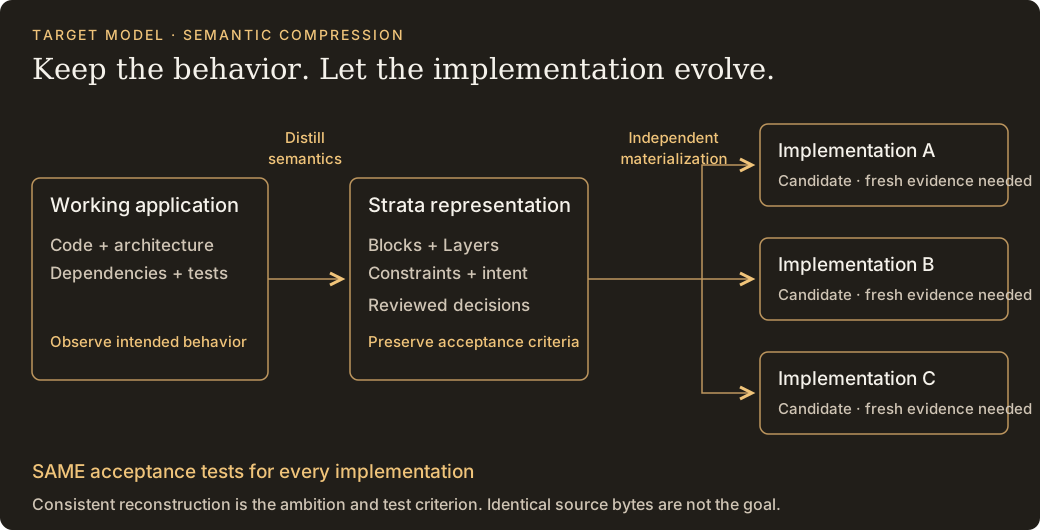
Think of it as semantic compression.
Keep the application’s intended behavior, constraints, and reviewed decisions in a durable representation. The implementation can change. Compression here means preserving meaning, not reproducing identical source bytes.
Consistent independent reconstruction is an ambition and a test criterion. Three implementations would each need to pass the same acceptance tests; these outputs are illustrative candidates.
Today’s profiles recognize finite intent. Arbitrary application synthesis, complete extraction, and guaranteed behavioral equivalence are not established. A new realization needs fresh evidence; changed intent returns through a reviewed Layer.
A contract for agent collaboration
More agents. Clear responsibility.
Use your existing agent framework through the CLI, or connect a separately configured coding-agent runner to self-hosted Studio. Strata defines how proposals become shared, reviewed application intent.
Shared context. Read authorized published intent across Layers.
Owned proposals. Write only to your own Layer; pin dependencies on peer revisions.
Explicit decisions. Route interactions to the responsible authority before publication.
A repeatable coordination pattern as work spreads across agents: follow who changed intent, which peer revisions it depends on, and who approved the decisions.
Illustrative simulation
Two useful changes. One shared decision.
A coupon and a shipping rule can each make sense alone. Compose them and the question becomes visible: which subtotal counts?
No actual code is generated or tested in this demo.
01 · Base intent
Checkout
Original subtotal $60. Free shipping at $50 or more; otherwise shipping is $7.
02 · Owned Layers
03 · Composition / Resolution
Conflict detected: two shipping rules
Illustrate a decision by the responsible authority:
04 · Checkout preview
Preview blocked
After coupon
$45
Shipping
Requires resolution
Total
Unavailable
05 · Separate Validation / Release gate
Validation disabled
Read the example: The base checkout is $60 with free shipping. Layer A adds a $15 coupon and checks the $50 threshold after discount: $45 + $7 = $52. Layer B checks the original subtotal: $60 with free shipping.
With both proposals, their shipping rules conflict. Keep both contributions visible, block the preview, and resolve which shipping rule applies. Choosing the discounted subtotal gives $52; choosing the original gives $45. Neither choice is validation. A real Release still needs implementation checks and required approval.
Enable JavaScript to toggle the Layers, choose a policy, reopen the decision, and simulate the separate validation gate.
This example makes a declared conflict explicit; it does not demonstrate automatic discovery of arbitrary contradictions. A real Resolution selects proposed behavior at exact revisions. Changed rules require reviewed owned proposals and authorized decisions.
Choose how intent becomes code.
A pinned implementation profile is a recipe: supported intent, stack, configuration, template versions, and checks. Templates supply the component, handler, and storage patterns that produce actual code.
Reviewed intentbooking.checkout
Confirm a booking only while its hold is active.
BBehavior
DDesign
DData
SSafety
Rule
Reject confirmation after the deadline, including a direct command.
Experience
Show the deadline, explain expiry, and make the expired action unavailable.
State
Represent a valid hold and preserve its exclusivity.
Facets overlap on requirements. Labels help review; they add no authority.
Illustrative future web profileProposed
One promise. A concrete implementation recipe.
Stack
TypeScript · React view · Worker handler
State
Versioned storage adapter
Recipe
Pinned templates, dependencies, and validators
Illustrative generated artifacts
Checkout.tsxDeadline, explanation, and action state
confirm-booking.tsAuthoritative active-hold check
hold-store.tsHold representation and exclusivity
expiry.test.tsBoundary and direct-command checks
Evidence for the actual output
Review rendered states. Exercise the command at expiry. Bind results to the exact candidate, profile, and generated files.
Requirement→Applicable targets→Artifacts→Evidence
A profile without a rendered view cannot fulfill this checkout experience. Uncovered or unsupported obligations block complete validation.
Developer Preview: The core supports exact-reference composition and finite implementation profiles. Self-hosted Studio adds intent browsing, owned drafts and explicit review actions. A bounded Windows Codex path has demonstrated a real proposal, an owner-saved draft, original-result recovery and Stop. The complete approved Release → saved Profile → Local Build journey is unfinished; completing and qualifying that flow follows publication. The web recipe above is a future profile. See implemented, tested and planned capabilities.
Intent travels in both directions.
Start with software that exists, or with a reviewed model. Keep people, working previews, and acceptance evidence in the loop.
DISTILL
From application to intent.
Inspect existing code and observed behavior. Propose intent with source traceability; people review which observations should become requirements.
MATERIALIZE
From intent to application.
Realize an exact candidate or Release under a pinned implementation profile. Produce working code, then preview and test that particular output.
Try the core: Start with the repository’s deterministic local demo. It uses fixture identities and finite examples, with no model or cloud calls. Read getting started and the implemented contract.
Self-host Studio: The development setup targets a Linux Node 22+ host behind HTTPS, your own Cloudflare Artifacts account and namespace, and a separately installed Windows coding-agent runner. Installation, permissions and native-host qualification remain explicit. This website is a static educational site.
Build in public: Follow the roadmap and verification boundaries. Profile → Build completion, unattended qualification and broader profiles remain ahead. General application synthesis and guaranteed reconstruction are not established.